Sunday, September 30, 2007

More Irish books

Between my latest library school class and writing reviews for the paper (latest one here), my efforts on poor spoonreader have been sporadic at best.
I have been reading though, making my way through some of the books I bought in Ireland.
  • Irish Tales of Mystery and Magic: a spooky-funny book about the ancients warrior clans of Ireland, with whimsical illustrations.
  • The Playboy of the Western World: a seminal play by John Synge that caused riots when it premiered in 1907 because of its comic treatment of patricide and its mention of women in their shifts (i.e. slips).
  • Hellfire: a contemporary novel about the drug trade among working-class Irish, with a female narrator, gypsy fortune-tellers and maybe ghosts. I just started this one so I'm still getting oriented.
I'm also thinking about overhauling spoonreader, maybe changing the focus or shutting it down and starting a new blog? I've been writing this blog for three years, which is kind of hard to believe. I'd like to post more often if I'm going to keep doing it. Maybe I need to just do that. Your thoughts?

Sunday, September 09, 2007

Trip to Ireland


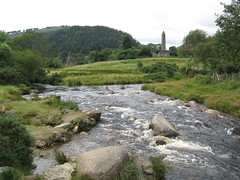
Glendalough
Originally uploaded by spoonreader
My 10-day trip to Ireland last month was spectacular, a real book lovers' treat. I'm working on some writing about that and will let you know when I'm done. Meanwhile, email me for my Flickr link if you'd like to see all the photos.
One favorite stop was the Martello Tower at Sandycove, where James Joyce lived for a brief time and the setting for the opening scene of Ulysses. ("Stately, plump Buck Mulligan ...")
Another was Glendalough, the ruins of an ancient monastic settlement founded by St. Kevin, circa 500 A.D. (This one really had me thinking of How the Irish Saved Civiliation.) Here's my favorite photo of the trip from Glendalough.

Elvis is Titanic

Here's a link to my review of Elvis is Titanic by Ian Klaus. It begins:

Ian Klaus' slim memoir of his time in Iraq, Elvis Is Titanic, stands out as one of the few civilian memoirs to come out of the Iraq War thus far. Klaus decided to swim against the tide by going to Iraq in 2005, at age 26, to try to make a difference by teaching English. Klaus also happens to be the former boyfriend of Chelsea Clinton, a fact that is neither here nor there - or even mentioned - until the end of the book.

Read more here.

Sunday, July 29, 2007

How the Irish Saved Civilization, and Writing as Act of Service

How the Irish Saved Civilization is a charming valentine written by Thomas Cahill, a tribute to Ireland's history as a book-loving culture. It starts during the Roman Empire, with its heritage of Greek intellectual life and the birth of Christianity. It moves forward to Christianity's spread across Europe and the arrival of the barbarians during the Dark Ages.

There's are splendid diversions concerning St. Augustine, who Cahill claims is the first author to create a psychological self-portrait, and the Irish epic poem Tain Bo Cuailnge, The Cattle Raid of Cooley. Then we come to St. Patrick, the brave nature lover, and eventually the monastic movement with its book-loving monks.

The heart of the book is that the Irish monasteries saved civilization by copying and preserving the great intellectual manuscripts of ancient Greece and Rome while Europe was plunged into the Dark Ages. Apparently the scribes would add their own little comments into the margins:

One scribe will complain of the backbreaking work of book-copying, another of a sloppy fellow scribe: "It is easy to spot Gabrial's work here" is written in a beautiful hand at the margin of an undistinguished page. A third will grind his teeth about the difficulty of the tortured ancient Greek that he is copying: "There's an end to that -- and seven curses with it!"
I particularly liked the chapter on the Tain, as the ancient Irish epic is called, which features a warrior-queen, Medb, who tries to capture the Brown Bull of Cuailnge so that her husband's fortune won't outrank her own.

Medb is fiery and spirited, and offers Daire mac Fiachna all sorts of treasure for the Brown Bull, "and my own friendly thighs on top of that." Another of the poem's heroes is Cuchulainn, a warrior who marries Emer. On meeting her, he declares, "I see a sweet country. I could rest my weapon there."

(If you've read Angela's Ashes, Cuchulainn is the Irish hero that young Frankie idolizes after his father tells him the story by the fire.)

I might add the Tain to my Irish reading list. The public libraries don't have it, but a few of the university libraries in my area have copies.

Saturday, July 21, 2007

Thoughts after reading Harry Potter (no spoilers)

Just finished the final Potter book. I don't want to post any spoilers at this point, so I'll just say it was quite good and did a remarkable job of keeping in the spirit of the whole series.
It's not giving away much to say this: I shouldn't have worried about getting enough on the early life of Albus Dumbledore. Thankfully, that was a major plot line -- hooray!

Friday, July 20, 2007

Thoughts before reading Harry Potter

About 2 and a half hours from now, I'll pick up my copy of the last Harry Potter book. I'm guessing I will finish it by Sunday night. What a wonderful trip it's been! My sister introduced me to HP right around the time Prisoner of Azkaban came out in 1999. Seven years later, these books have brought a lot of happiness to my life. There's something so fun about a series, and J.K. Rowling hit all the right notes.
My personal predictions -- no spoilers here, these are just guesses -- are that Harry lives, Voldemort dies, Snape is good, Dumbledore does not return. Harry ends up with Ginny, and Hermione ends up with Ron, and they all live happily ever after. Who will die? I hate to say it but I think it's Mrs. Weasley and Hagrid.
I'm most worried that we won't get sufficient back-story on Lily Evans and Neville Longbottum. I'd also love to know more about Dumbledore's early life, but I'm not holding my breath for it. I also wonder what will happen to Draco Malfoy.
OK, that's it! I've got to get ready ...

Thursday, July 12, 2007

Dark but funny childhood memoirs

I wasn't going to read Angela's Ashes for the Irish reading project, because we're not going to Limerick, where much of it is set. But I decided to get the audio book read by the author Frank McCourt from the library, to liven up my commute. It's a pretty humorous memoir of a truly disturbing childhood. Maybe someone should write a doctoral thesis comparing it with similar memoirs The Glass Castle and Running with Scissors.

So here's my favorite part so far. A school master is chastising his students for making fun of the narrator Frank, who has to wear shoddily patched shoes to school, because he's so poor:
He says, There are boys here who have to mend their shoes whatever way they can. There are boys in this class with no shoes at all. It's not their fault and it's no shame. Our Lord had no shoes. Our Lord died shoeless. Do you see Him hanging on the cross sporting shoes? Do you, boys?
No, sir.
What don't you see him doing?
Hanging on the cross sporting shoes, sir.
Then the teacher threatens to wallop them all with a switch.

Sunday, July 08, 2007

Librarians in the Press

The New York Times snaps to the fact that librarians are way cool. Here's the nutgraf:

Librarians? Aren’t they supposed to be bespectacled women with a love of classic books and a perpetual annoyance with talkative patrons — the ultimate humorless shushers?

Not any more. With so much of the job involving technology and with a focus now on finding and sharing information beyond just what is available in books, a new type of librarian is emerging — the kind that, according to the Web site Librarian Avengers, is “looking to put the ‘hep cat’ in cataloguing.”

Wednesday, July 04, 2007

Harry Potter Reading Project Update

Since June 1, I have re-read two of the six Harry Potter books -- Book 1 (Harry Potter and the Sorcerer's Stone) and Book 6 (Harry Potter and the Half-Blood Prince). I am currently re-reading Book 5 (Harry Potter and the Order of the Phoenix). I'm not sure if I will have re-read all six before the final book comes out on July 21, but I'm going to try! (I also have other non-HP books I'm reading, too.)
I'm re-reading for the following reasons:
  • 1. for fun!
  • 2. to mine for clues to the final ending.
Years ago, I read an opinion piece on an HP fan web site -- sadly I can't remember where. It said we current Harry Potter fans are blessed to be able to read the books as they come out, to be able to savor the anticipation between books. Future readers will probably come at the series differently, reading them in sequence much faster. Some children will no doubt spend a long weekend reading all seven books in one big gulp. And their experience will be quite different from the years we current readers -- we few, we happy few (relatively speaking)-- have invested in looking for clues, contemplating themes and teasing out meaning.
That sentiment hangs on whether you believe the Harry Potter books will be read for generations to come. I think they will -- they are that good, embracing enduring themes, like what it means to live a good life in the face of inevitable death. Time will tell.

Sunday, July 01, 2007

Wallace on YouTube

A YouTube user called dazzlecomm has posted a bunch of video on YouTube from a writers conference held last year in Italy called Le Conversazioni. The attendees last year included my favorite David Foster Wallace along with Zadie Smith, Jeffrey Eugenides, and others. (I vow to finally read Eugenides' Middlesex now that it's Oprah's pic.)


Check out the above clip from David Foster Wallace. I transcribed what he's saying, it's just a short couple of sentences. It seems to be a response to a question about whether he belongs to a school of writers, though we don't get the question. So I'll notate it Wallace-style:

Q.
A. One symptom of what you could call the American disease, is that I don't know any writers who think of themselves as like other writers. Critics often group writers together more than writers do.
I would say that there's a group of American writers who tend to use more the techniques of postmodernism and experimentation, and then there's a group of traditional, sort of more realistic writers. Many of the writers I admire, and (unintelligible) whether I'm one of them, are interested in using postmodern techniques, postmodern aesthetic, but using that to discuss or represent very old, traditional human veritities that have to do with spirituality and emotion and community, ideas that the avant-garde would consider very old-fashioned. So that there's a kind of melding -- It's using postmodern formal techniques for very traditional ends.
If there is a group -- and some of whom I think are here this week with me -- If there is such a group, that's the group I want to belong to.
I think that description is right on the money as far as Infinite Jest goes. (Have I mentioned lately that I love that book?) Some of his other writing, I'm not so sure about. The book that continues to vex me is his short story collection "Brief Interviews with Hideous Men" -- I just don't know what to make of it. And they're making it into a movie, can you believe that? I think I need to read that book again. I read it at a point in my life when I was very melancholic, and I have often wondered if I saw it through a dark lens, so to speak.
On another issue, in light of the recent New Yorker article on the Ransom Center's literary archive, how does a library preserve video like this? The reason I transcribed the quote is because the video could go away for any number of reasons (not least of which would be complaints from conference organizers or DFW himself). I think it's valuable from a literary-historical point of view to hear what writers have to say about their own writing, and the fledgling librarian in my instinctively says such video should be preserved for research purposes. I wonder if the Ransom center has multimedia archivists? Hmmm ...
On a related note, the spouse is always hassling me to archive this blog is some way, but I'm lazy, and I have confidence that the Google servers will keep chugging along. From an archival point of view, I should print it out though, on acid-free paper and store it in a fire-proof box somewhere. (The difficulties inherent in digital archives are a post for another day; I'll put it on my list of future posts.)

Sunday, June 24, 2007

My Ireland Reading List, Part 1

We're going to Ireland for our fifth anniversary of marriage, yippee!
So here is the start of my Ireland reading list. (I'll spare you my Ireland Netflix list.)

Saturday, June 23, 2007

The art of the book cover

Love this ... a whole blog dedicated to the design of book covers., with a special attention to the differences between international editions. (The blogger is Canadian and receives editions from both the U.S. and Europe, so this makes sense.)
I particularly enjoyed the recent post on new covers for Vintage Classics like Sense and Sensibililty and Frankenstein. Check out that post here.

Sunday, June 17, 2007

Homeless library users

Many homeless people use the libraries in Tampa, and I wanted to talk to some of them and see what they read and what they think of the local libraries. I ended up writing a profile for the paper of a woman I got to know in Clearwater, a nearby city.
You can read my story via this link here.
Just last week, USA Today had a story about how some libraries are offering specific service to homeless people. I didn't find anything like these programs going on in our area, but I sure would like to write about it happens. Read the USA Today story here.

Saturday, June 16, 2007

Happy Bloomsday!

Today is Bloomsday, when we honor James Joyce and the novel Ulysses. From RTE:

It is considered to be the greatest novel of the 20th century.

All the events in James Joyce's epic Ulysses happen on a single day - 16 June 1904 aka Bloomsday.

A week's worth of celebrations have been taking place throughout Dublin, but Bloomsday itself is still the one that matters.

Dublin 1904, as Leopold Bloom knew it, comes to life as you can eat, walk, swim, listen to, re-enact, or watch the eclectic mix of Bloomsday events.

Here are just some of the events taking place ...


Read all about it here.

Bloomsday is my favorite literary holiday, along with J. Alfred Prufrock Day and Michaelmas.

Harry Ransom Humanities Research Center

The New Yorker profiles the Harry Ransom Humanities Research Center, one of the largest literary archives in the world and part of my dear alma mater, the University of Texas at Austin.
It's a fascinating article -- the sheer size of some of these collections of writers' papers; the business of buying collections; the ambition of the center to be the top scholarly archive in the country; and the personality of its raconteur director Thomas F. Staley (a James Joyce scholar, no less -- the center's holdings on Joyce are remarkable). Read the article online at The New Yorker web site while it's still available here.
The story, written by D.T. Max, fills me with admiration for archives and what they mean to literary history and heritage. It also makes me want to read more Don DeLillo, because of his connection Joyce and David Foster Wallace, as this excerpt shows:
One day this spring, I flew to Austin to take a look at the Don DeLillo archive. The Bronx-born writer, whose papers Staley acquired in 2004 for half a million dollars, fits into the Ransom’s collection well: for one thing, DeLillo is part of a node of expansive American fiction that goes back to Philip Roth and forward to novelists such as Jonathan Franzen, Rick Moody, and David Foster Wallace; DeLillo has corresponded with all of these writers. DeLillo counts Joyce as an influence, so he connects to the modernist node. And he has kept engaging, detailed notebooks that shed light on the intellectual foundation of his novels. Most important, he writes on a manual typewriter, producing draft after draft of his work, allowing scholars a chance to see his creative mind at work.

D.T. Max is my new favorite journalist. He also wrote a really good NYT mag piece on Happiness 101, about researchers who study true happiness.
As for the Ransom Center, it's that kind of UT effort that makes me wanna shout "Hook 'em, Horns!"

Thursday, June 14, 2007

Harry Potter Read-a-thon

Here's a series of emails between me and my dear book group friend L.

L.,
I want to re-read all the Harry Potter books before No. 7 comes out in July. Do you think I should read them in order, 1, 2, 3, 4, 5, 6? Or do you think I should read them backwards -- 6, 5, 4, 3, 2, 1 ?

It would make sense to read them 1-6, but I was thinking I might detect more clues to the ending by reading them backwards.

What do you think?
--Angie

Angie,
I'm in the process of re-reading the last one. If you have enough time, start at the beginning. What if you burn out though and then stop reading by book 4 and then book 6 is untouched as you are in line to get the new book?

If I were intent on reading them all, I would start with 6 and then 1,2, 3, 4, 5.
--L.

L.,
I think your point about burn-out is a good one! And I hadn't thought of that before, but I think you're right.

I started Book 1 this weekend and I'm almost done. Maybe I'll do 1, 6, 2, 5, 4. Mark jokingly suggested that, but I don't think it's a bad idea!

I have a hunch that Book 2 is more important than we might think, because it has so much of Voldemort's boyhood and the diary was likely a Horcrux, etc. So I want to get that one in if I can.

What fun!
--Angie

Sunday, June 10, 2007

What Writers Recommend

What do writers read? It's an interesting enough question that two summer reading news stories have recently asked that question.
In New York magazine, Benjamin Kunkel, author of the wonderful whimsical-yet-serious debut novel Indecision, recommends Mortals by Norman Rush. Mortals is a sequel to an interesting novel called Mating that my book group read last year. Both "Mating" and "Mortals" are about American intellectuals and government workers in Botswana. Kunkel's novel "Indecision" has slightly similar themes of Americans and their place in their international scene, but "Indecision" is more youthful and zany, while "Mating" was serious and a teensy bit pretentious (but kind of enjoyably so). The whole New York package on summer reading is pretty interesting and worth looking at.
Meanwhile, the NYT has a big roundup of what famous authors are reading. I was pleased to see Stephen King recommend Then We Came To The End. I loved that book, I think it deserves a wider audience.

Monday, June 04, 2007

Presumed Innocent sequel

A news report says Scott Turow is working on a sequel to Presumed Innocent, one of my favorite novels:

"I got the idea a couple of years ago when I was working on a serialized book for The New York Times," explained Turow at the Jacob Javits Convention Center. "I had this image of a man sitting on a bed, near the body of a dead woman. And then I realized, 'Wait a minute, that guy on the bed is Rusty Sabich!' And that's how I began the new book." ...

"I've gotten a lot of correspondence saying that `Presumed Innocent' was an epochal event in the reader's life," Turow said, adding that the new novel, currently untitled, would probably not come out before the summer of 2009.

Read the whole news report here.

I would quibble that Burden of Proof was a sequel to "Presumed Innocent." "Burden" is about Sandy Stern, Rusty Sabich's defense attorney, who was so memorably portrayed by Raul Julia in the movie of the novel. I loved that one two. Every couple of years I re-read those novels, just for fun.

Saturday, June 02, 2007

Cheever's "The Swimmer"

My spouse wrote a news story about swimming the city's public pools in a single day. (Read it here.) He mentions the short story "The Swimmer," by John Cheever in the beginning. I'd never heard of this short story before the spouse started talking about it, but it's terrific. Neddy Merrill is at a friend's house when he decides to swim home, going from pool to pool in his affluent neighbors' backyards. As he swims he realizes that something isn't right, that his world is changing as he goes along.
The story isn't online, but there's an interesting tribute to it written by Michael Chabon (author of The Yiddish Policemen's Union and The Amazing Adventures of Kavalier and Clay) in Salon. Read it here. It starts:
I read "The Swimmer" for the first time on my bed in the Maryland suburbs, one winter afternoon when I was sixteen or seventeen. I'd been skimming through a battered paperback anthology my grandfather had passed along to me -- "100 Stories Ruined by English Teachers," I think it was called -- starting one after another worn-out old chestnut, quickly moving on, when I reached the famous, classic, puzzling first paragraph that begins, "It was one of those midsummer Sundays when everyone sits around saying, 'I drank too much last night.'"
Chabon talks about how the story meditates on the inevitability of life's end. That's true, but I think it's also about the isolation of addiction. There's a lot going on there.
I can't find the story to link to; it's still under copyright. So go to your local library to find it; it's well worth reading.

Tuesday, May 29, 2007

The Moleskine talks back

Here's a quick piece from McSweeney's on what your abandoned journal might say.

It starts:
You say things are "hectic." Then you add that you "don't want to talk about it." And that's all? Nothing else happened to you on April 22, 2007? Well, if I'm to believe that, then my name isn't Moleskine.


Read the rest here

Then We Came to the End

I really adored the book, Then We Came to the End, by Joshua Ferris.
Funny and touching and deeply serious, "Then We Came to the End" is what happens at a Chicago ad agency as the dot-com bubble bursts and the lay-offs begin.
And it's written in first-person plural! (For the most part.) How cool is that?
Because I'm an office worker myself, this book reminded me that there's so much drama and poignancy in everyday life. This point has been made before (most notably by James Joyce's Ulysses), and maybe it's an easy, obvious point. But I still find the phenomenon to be emotionally moving and almost miraculous. Such is the artistry of the novel.
I interviewed Joshua Ferris for the newspaper, which was great. Some authors I've interviewed don't like talking about their work, but Ferris was very articulate, especially about the different characters in his book.
Read my interview with Joshua Ferris here.
Read the first chapter of Then We Came to the End here.
Here's the opening:
WE WERE FRACTIOUS AND overpaid. Our mornings lacked promise. At least those of us who smoked had something to look forward to at ten-fifteen. Most of us liked most everyone, a few of us hated specific individuals, one or two people loved everyone and everything. Those who loved everyone were unanimously reviled. We loved free bagels in the morning. They happened all too infrequently. Our benefits were astonishing in comprehensiveness and quality of care. Sometimes we questioned whether they were worth it. We thought moving to India might be better, or going back to nursing school. Doing something with the handicapped or working with our hands. No one ever acted on these impulses, despite their daily, sometimes hourly contractions. Instead we met in conference rooms to discuss the issues of the day.

Tuesday, May 22, 2007

What I'm Reading Now

I'm reading The Annotated Pride and Prejudice by Jane Austin, annotated by David M. Shapard. P&P is a classic, but I read it for the first time only a year or two ago. Now I love it, this is maybe my fourth time reading it. The annotated edition has lots of interesting insights about how Jane Austen moves her plot along almost entirely through dialogue -- very interesting. It also explains nuances of vocabulary that might slip by the modern reader, i.e. amiable: "a common term of praise. It had a broader meaning then, signifying general kindness and friendliness."
I'm also reading The Untouched Minutes by Donald Morrill. It's a fascinating memoir by an English professor about how he and his wife were victims of a home invasion. It's kind of a slim book, I would describe it as a literary essay. The home invasion happened around the same time as 9/11 and the murders of Half and Susanne Zantop, two professors at Dartmouth. Morrill weaves those events into his narrative to create a meditation on violence and experience. So far, it's excellent.

Sunday, May 20, 2007

My strategic borrowing

If I'm browsing the stacks at a library and I run across a book I like but might not have time to read, I will check it out anyway with the idea that it will improve the book's library survival. Books that don't get checked out for years tend to lose their place on the shelves and end up on the book sale tables, and this is my little way of forestalling that.

But it's hard to tell sometimes when the last time a book was checked out. It used to be, you could flip to the back of the book and check the date due stamp. With the advent of computerized check-out, though, the dates don't always get stamped. So I ask the librarian. They usually can tell me.

Example: I recently checked out a copy of Flannery O'Connor's collected works. The stamp said the last check out date was 1995. But I asked the library assistant to look it up, and the last actual check out date was 2005.

Author letters

Reader No.7 sent me this fascinating link about 300 letters written by Flannery O'Connor that were made available to the public for the first time last week:

By outward appearances, Betty Hester was an unremarkable woman. She never married or had children, living instead with an aunt in a Midtown apartment. She rarely went out for fun. She took the bus each day to work as a file clerk for a credit bureau in downtown Atlanta.

Few people knew that Hester — an avid and insightful reader — was a close friend and confidante of the world-renowned Georgia author Flannery O'Connor, although the two rarely met in person. Over the course of nine years, though, from 1955 until O'Connor's death in 1964, they wrote to each other nearly every week, discussing everything from Catholicism to current events in wide-ranging letters that were "the most personal" of O'Connor's correspondence, according to Bill Sessions, Hester's literary executor.

In an event highly anticipated by O'Connor scholars and fans, her nearly 300 letters to Hester will be opened to the public Saturday at Emory University, where, at Hester's request, they have been kept under seal for 20 years.


The article is mostly about O'Connor, but it also notes that there is a sizable trove of letters by T.S. Eliot that are under seal -- 1,200 letters that will be opened in 2020.

Then there's a follow-up to the O'Connor story, about what happend on the day the letters were released:

Maybe it was just too sunny a day to be spent in the archives on the 10th floor of the Robert W. Woodruff Library on Emory's campus. By 2 o'clock — five hours after the correspondence in two large folders was made public — only five people had signed in and perused the collection of letters written between 1955 and the author's death in 1964.

Larry Hammond, 65, an insurance salesman from Atlanta, was the first to thumb through the stack. "I took a literature class a few years ago and read about this and I was just interested," he said. "I was real surprised by the language — and all the typos."

A closer inspection by O'Connor scholars may yet find great gravity in the missives.

Friday, April 20, 2007

The Movie of Us

I recently reviewed The Movie of Us, a collection of poetry by Kevin Jeffery Clark. The book has an interesting back story; I wrote about it here.
Excerpt:
The Movie of Us captures a cinematic landscape of language. The poems are scenes sketched out in the cool blues and grays of a lake photographed just after sunset or just before dawn.
I attended a poetry reading last night; Clark's brother, Michael Klein, read his poems. It was quite touching.

Tuesday, April 17, 2007

The Glass Castle and The Road

I read The Glass Castle right before I read The Road, so that's two books about pitiful starving children in a row. Meanwhile, the next book group pick is Love in the Time of Cholera by Gabriel Garcia Marquez.

I also can't stop thinking about a bit from Cormac McCarthy's NYT interview, which I blogged about yesterday:
McCarthy's style owes much to Faulkner's -- in its recondite vocabulary, punctuation, portentous rhetoric, use of dialect and concrete sense of the world -- a debt McCarthy doesn't dispute. "The ugly fact is books are made out of books," he says. "The novel depends for its life on the novels that have been written." His list of those whom he calls the "good writers" -- Melville, Dostoyevsky, Faulkner -- precludes anyone who doesn't "deal with issues of life and death." Proust and Henry James don't make the cut. "I don't understand them," he says. "To me, that's not literature. A lot of writers who are considered good I consider strange."

His is a very purist view of writing. I admire his view, but I'm not sure I share it. It's a great point for debate, though.

Monday, April 16, 2007

More on The Road

So today The Road wins the Pulitzer Prize when I was just blogging about it yesterday. I did some more research on the book today, one interesting piece was from The Chicago Tribune about Oprah picking the The Road for her book club. The writer, Julia Keller, calls Oprah and author Cormac McCarthy "one of the oddest and most unlikely cultural pairings since Arthur Miller and Marilyn Monroe." She also reports on McCarthy's notorious aversion to the press:
Whatever McCarthy's motivation for agreeing to be on the show, it isn't money, say longtime observers of McCarthy's work. He turns down speeches, awards, teaching gigs and other familiar trappings of the contemporary writer's life, preferring to live in the desert Southwest and do his work. Like literary recluses such as J.D. Salinger and Thomas Pynchon, McCarthy is more familiar through his absence than his presence.

Read the whole article here.

I also found this longer, more definitive profile of McCarthy from when he gave a rare interview to the New York Times in 1992. You can find it via the previous link or on the NYT's Cormac McCarthy page here.

Sunday, April 15, 2007

Oprah's Pic: The Road

I read Oprah Winfrey's current book club pic this weekend: The Road, by Cormac McCarthy. I can't remember the last time I read a book this disturbing. A man and his young son are on the road, traversing a post-apocalyptic landscape (nuclear war? meteor strike?) and hiding out from other survivors bent on rape, murder and cannibalism.
If that sounds austere, it certainly is, but the writing is elegant and convincing. I can't get some of the grimmer scenes out of my head.
I would say the pick is out of character for Ms. Oprah, but one of the things I like about Oprah (and I do like her) is that she usually has a surprise up her sleeve. So it's not out of character in that sense.
The Oprah web site says that Cormac McCarthy is going to give her his first television interview. I'm sure the chance to reach the massive Oprah audience is to tempting to pass up. (Only one author ever did, I think.)
Maybe I'll think of something more profound to say upon further reflection, but right now all I can do is shake my head in disbelief over the power of The Road.

Thursday, April 12, 2007

Kurt Vonnegut, RIP

Slaughterhouse-Five is one of the great anti-war novels, maybe the best in American literature. My eighth grade English teacher used the book to teach World War II to us Catholic school girls, which seems smartly subversive to me now. I need to find a copy and re-read it.
It begins like this:
Listen: Billy Pilgrim has become unstuck in time.

Then it tells about Billy's serving in World War II and surviving the bombing of Dresden; his postwar life in the suburbs; his capture by aliens and being taken to another planet.
After reading that book, I went ahead and read all the rest of his books before I graduated high school; I loved them. He was the first adult author who I read pretty much all of his work. The obits (read the NYT one here) have been mentioning Cat's Cradle and God Bless You, Mr. Rosewater as his major works, but I always preferred Breakfast of Champions, which has sly illustrations of human anatomy and features the trials of his alter-ego, science fiction writer named Kilgore Trout.
Later in life, Vonnegut defended civil liberties and librarians.
Kurt Vonnegut died yesterday. So it goes.

Saturday, April 07, 2007

The dreaded "twee" appellation

My book group is preparing to discuss Eat, Pray Love: One Woman's Search for Everything Across Italy, India and Indonesia by Elizabeth Gilbert. I really liked it -- I've been a fan of Gilbert's ever since I came across her distinctive chatty-but-smart magazine stories in GQ years ago. This book is a memoir Gilbert's emotional recovery from a painful divorce. Her solution is to seek pleasure worldwide by eating in Italy, praying in India and finding balance in Indonesia. It's a clever premise, and in the end the book moves beyond her divorce to her spiritual maturation as a complete woman. Her writing is a joy -- breezy, funny and modern. And I really liked the way she documented the hard-to-describe feelings of silent meditation.
But I fear my dear book group compatriot J. is not going to like it. I can hear her now, she will tag it with the dreaded "twee" appellation. What is twee? Twee is anything that J. considers too cutesy or precious or sweet or clever for it's own good. It's the opposite of J.'s most complimentary adjectives, which are -- can you guess? -- "ironic" and "dark" (and sometimes "sarcastic"). Other books we have read that J. said were twee are Winkie by Clifford Chase (a satirical memoir in which a teddy bear becomes ensnared in a terrorist plot) and The World to Come by Dara Horn (a cross-generational love story celebrating Jewish art and literature, hinged around a stolen Marc Chagall painting).
So I'm thinking up my twee counterarguments now.

Wednesday, March 28, 2007

Seth Compton

I get new comments on one of my earliest posts, Why Spoonreader?, every so often, which is great. I hope it means that people interested in Spoon River Anthology are finding this blog. One commenter recently pointed out a poem that had never really made an impression on me before, which is kind of funny, since it's about libraries. You'd think I would have remembered it.
Then later, my friend RF and I were talking about our mixed feelings about small towns, and growing up in small towns. (He grew up in Mansfield, population 5,582. I grew up in Patterson, population 5,130.) Calling it a love-hate relationship vastly oversimplifies it. It's more of a combination of nostalgia, affection, respect, frustration, revulsion and rage. It brought that same poem back to mind.
Anyway, here's the Spoon River poem that gets at all that. Thanks, Naomi!

SETH COMPTON

WHEN I died, the circulating library
Which I built up for Spoon River,
And managed for the good of inquiring minds,
Was sold at auction on the public square,
As if to destroy the last vestige
Of my memory and influence.
For those of you who could not see the virtue
Of knowing Volney’s “Ruins” as well as Butler’s “Analogy”
And “Faust” as well as “Evangeline,”
Were really the power in the village,
And often you asked me,
“What is the use of knowing the evil in the world?”
I am out of your way now, Spoon River,
Choose your own good and call it good.
For I could never make you see
That no one knows what is good
Who knows not what is evil;
And no one knows what is true
Who knows not what is false.

Tuesday, March 20, 2007

'80s Books and Food

I read a poignant, fun memoir of growing up Vietnamese in the '80s in Michigigan, and eating lots of junk food: Stealing Buddha's Dinner, by Bich Minh Nguyen. (Check out the short interview and excerpt I wrote here.) I have a real weakness for '80s culture, since that's the decade I grew up in. This memoir reminded me a lot of a Judy Blume book. In fact, Judy Blume wrote a blurb for the back of the book: "Only a truly gifted writer could make me long for the Kool-Aid, Rice-A-Roni, and Kit Kats celebrated in Stealing Buddha's Dinnner. In this charming, funny, original memoir about growing up as an outsider in America, Bich Nguyen takes you on a journey you won't forget. I can hardly wait for what comes next."
Just in case you possibly don't know who Judy Blume is: She wrote '80s teen classics such as "Are You There God? It's Me, Margaret" (which actually was published in 1970).
Nguyen's working on a novel called "Short Girls" that I'll be interested in reading.

Sunday, February 25, 2007

Quality of Reading

After reading interviews with Zadie Smith and essays by her, and being impressed with how sharp and interesting she is, I finally -- finally -- got around to reading On Beauty. I liked it very much; this novel has sophistication and depth. It is the story of two black families -- one mostly American and one British; one liberal, one mostly conservative -- who intersect at a small liberal arts college near Boston. The book takes on the culture wars, black identity, class issues, love and fidelity, and, of course, beauty.
Playing alongside the novel for me, though, has been Smith's essay on the importance of reading. Her analogy of a violinist playing a composer's work haunts me, because I play the violin, and I know there are diligent ways to practice and sloppy ways to practice. It makes me wonder, am I reading sloppily? Am I doing justice to the work I'm reading?
I've often thought that I sometimes read books too fast to really enjoy and even digest them. Books that I find to be clearly and simply written are books that I read fast -- books like Harry Potter and authors like John Grisham and Anne Rice. With Harry Potter, I've noticed myself reading about half of each sentence, getting the gist of where it's going, and skipping to the next sentence. (I suspect that's what most speed readers do.) But even books that are written with a more complex style, sometimes I tear through those, too. So lately I've been trying to consciously slow down, to read a little slower, to savor the language more.
But what else do I do that's bad? How about stopping in the middle of the chapter, or even worse, in mid-sentence? I certainly do that sometimes. Isn't that doing harm to the reading of the work to stop at an unnatural stopping point?
So I've been trying to be more respectful in my reading -- not reading right before bed when I'm exhausted, or when I don't have enough time to finish a chapter. It's definitely slowing me down. But hopefully it's making me a better reader, too.

Saturday, February 24, 2007

Harry Potter in 2007

I know I'm super late on posting this, but I am so thrilled that the last Harry Potter book will be published this year on July 21, less than 150 days away as of this writing. (You can check the countdown on mighty Mugglenet's homepage.) I was really worried that it wouldn't come out until 2008.
These books are fanciful and funny, and impossible to put down. Each chapter ends in a way specially designed to irresistibly (literally!) lure you on, until you've fin shed the whole darn thing. In some ways, they are like literary heroin. They get a powerful grip on you.
I made a pact with myself after seeing the third Harry Potter movie (Harry Potter and the Prisoner of Azkaban, which was quite good) that I wouldn't watch anymore of the movies until I had finished reading the whole series. I don't like the movie images in my head when I read the books. So far, so good.

Tuesday, February 06, 2007

Flannery O'Connor Pilgrimage

The New York Times has a marvelous travel story about visiting the birth place of Flannery O'Connor. It's very much worth reading if like her. Hurray for the writer, Lawrence Downes! I love the way he encapsulates the O'Connor body of work. He writes:
O’Connor’s short stories and novels are set in a rural South where people know their places, mind their manners and do horrible things to one another. It’s a place that somehow hovers outside of time, where both the New Deal and the New Testament feel like recent history. It’s soaked in violence and humor, in sin and in God. He may have fled the modern world, but in O’Connor’s he sticks around, in the sun hanging over the tree line, in the trees and farm beasts, and in the characters who roost in the memory like gargoyles. It’s a land haunted by Christ — not your friendly hug-me Jesus, but a ragged figure who moves from tree to tree in the back of the mind, pursuing the unwilling.
Many people — me for instance — are in turn haunted by O’Connor. Her doctrinally strict, mordantly funny stories and novels are as close to perfect as writing gets. Her language is so spare and efficient, her images and character’s speech so vivid, they burn into the mind. Her strange Southern landscape was one I knew viscerally but, until this trip, had never set foot in. I had wondered how her fictional terrain and characters, so bizarre yet so blindingly real, might compare with the real places and people she lived among and wrote about.

I also got a real kick out of how my friend L. sent me an email about the story, noting that it included our friend J.'s favorite line from a Flannery O'Connor story. She didn't even have to include the line. I knew exactly which one she meant: “She would of been a good woman,” the Misfit said, “if it had been somebody there to shoot her every minute of her life.”
Read the whole NYT story here.

Saturday, January 27, 2007

Introduction to IJ's 10th Anniversary

While I was working on a review of What is the What: The Autobiography of Valentino Achak Deng, by Dave Eggers, I was surfing around the Internet looking for stuff about Eggers. One of the things I found online was the introduction he wrote for the tenth anniversary edition of Infinite Jest by David Foster Wallace.
I really love the introduction. It begins:
In recent years, there have been a few literary dustups — how insane is it that such a thing exists in a world at war? — about readability in contemporary fiction. In essence, there are some people who feel that fiction should be easy to read, that it’s a popular medium that should communicate on a somewhat conversational wavelength. On the other hand, there are those who feel that fiction can be challenging, generally and thematically, and even on a sentence-by-sentence basis — that it’s okay if a person needs to work a bit while reading, for the rewards can be that much greater when one’s mind has been exercised and thus (presumably) expanded.

Much in the way that would-be civilized debates are polarized by extreme thinkers on either side, this debate has been made to seem like an either/or proposition, that the world has room for only one kind of fiction, and that the other kind should be banned and its proponents hunted down and, why not, dismembered.

Read the whole introduction here. (And you really should!)

Sunday, January 21, 2007

Zadie Smith on the Novel

Zadie Smith has authored a truly wonderful essay on writing novels in the Guardian. She asks what makes a good writer and responds to T.S. Eliot's famous essay, "Tradition and the Individual Talent."
My favorite part of the essay is where she talks about the role of the reader:
A novel is a two-way street, in which the labour required on either side is, in the end, equal. Reading, done properly, is every bit as tough as writing - I really believe that. As for those people who align reading with the essentially passive experience of watching television, they only wish to debase reading and readers. The more accurate analogy is that of the amateur musician placing her sheet music on the stand and preparing to play. She must use her own, hard-won, skills to play this piece of music. The greater the skill, the greater the gift she gives the composer and the composer gives her.

This is a conception of "reading" we rarely hear now. And yet, when you practise reading, when you spend time with a book, the old moral of effort and reward is undeniable. Reading is a skill and an art and readers should take pride in their abilities and have no shame in cultivating them if for no other reason than the fact that writers need you.

Read the whole essay here.
(Thanks to Gangrey for the link.)

Sunday, January 14, 2007

Poems for a weekend at home

Here are some good poems for a weekend at home.

For when you need an exterminator:
Me up at does
by e.e. cummings

For when you eat your loved one's snacks:
This Is Just To Say
by William Carlos Williams

For tending tomato plants in the garden:
Hornworm: Autumn Lamentation
by Stanley Kunitz

Oh Joy

One of my favorite things about being a graduate student at the University of South Florida is that when I check books out of the library, I get them for a whole semester. That is just cool.

Sunday, January 07, 2007

Best Books of 2006

In the spirit of High Fidelity, here's my Top 5 all-time best books of 2006 (in order):
1. What is the What: The Autobiography of Valentino Achak Deng by Dave Eggers
Eggers stuns again with an astounding tale of children surviving the civil war in Sudan. Valentino is as compelling a child narrator as any from Charles Dickens.
2. The Looming Tower: Al-Qaeda and the Road to 9/11 by Lawrence Wright
New Yorker staff writer Lawrence Wright makes the world of Islamic fundamentalists frighteningly understandable for American readers, with additional insights on the U.S. intelligence community. A must-read for anyone who cares about the global war on terror.
3. What Jesus Meant by Garry Wills
A refreshing and much-needed intellectual approach to the New Testament Gospels. Wills refutes literalists and argues for a Christianity that is a compassionate religion of the heart.
4. Severance: Stories by Robert Olen Butler
Beautiful prose-poems on the unlikely theme of decapitation. Moving, gruesome and thoughtful.
5. A Spot of Bother by Mark Haddon
Haddon takes the life of a semi-dysfunctional British family and infuses itwith drama and redemption. This was the very different second novel from the author of best-seller Curious Incident of the Dog in the Nighttime. I can't wait to read what he writes next.

Honorable Mentions:
Blind Side: Evolution of a Game by Michael Lewis
A poor black kid from inner city Memphis attends a wealthy evangelical Christian high school. He gets adopted by a white family and becomes the most sought after football prospect in the state. With meaningful thoughts on the business of sports, the evolution of the NFL and the nature of familial love. (Whew!)
Mockingbird: A Portrait of Harper Lee by Charles J. Shields
Shields unpacks the life of the reclusive (and still living) Harper Lee, author of To Kill A Mockingbird. Paints a great you-are-there picture of the New York literary scene for southern writers in the 1960s.

Three great books I read in 2006 that were not written in 2006:
Kafka on the Shore (2005) by Haruki Murakami
Simultaneously trippy and realistic, this is a grand adventure story where a boy named Kafka saves the world from evil incarnate that takes the form of the guy Johnnie Walker liquor bottle.
We Wish to Inform You That Tomorrow We Will Be Killed With Our Families: Stories from Rwanda (1998) by Philip Gourevitch
Gourevitch explains the unexplainable: the 1994 genocide in Africa.
Harbor (2004) by Lorraine Adams
A former Washington Post reporter writes a first novel about Algerian immigrants in the U.S. today.

Saturday, December 30, 2006

Blind Side review

I wrote a review of Blind Side by Michael Lewis for the SPT. Read it here. I blogged about the book previously here.

Best of Lists

I love the "best of" lists that come out at the end of the year. And this year's seem like a diverse bunch. Here are links with notations of what I've read and would like to read. Suffice to say, all these books seem pretty darn good. Here's my round-up and comments on some of the lists. Or you can save yourself precious minutes and go straight to Metacritic's ultimate best books of 2006 page.

The New York Times Ten Best Books of 2006.
I've read The Looming Tower; I'd like to read The Places in Between, by Rory Stewart, about travels through Afghanistan.

The Washington Post Top Ten Best of the Year.
Again The Looming Tower; would like to read Fiasco, an accounting of the Iraq War by Washington Post writer Thomas Ricks.

The Atlantic Monthly Books of the Year. (Subscription required, I believe.)
I haven't read *any* of these. (Shame!) I would like to read Twilight of the Superheroes: Stories by Deborah Eisenberg and All Aunt Hagar's Children by Edward P. Jones.

The Los Angeles Times has two fairly long lists: Favorite Fiction and Poetry of 2006 and Favorite Nonfiction of 2006.
I'm overwhelmed by the number of pics here. The nonfiction list is more interesting. I'd like to read The Lost: A Search for Six of Six Million by Daniel Mendelsohn and The Worst Hard Time: The Untold Story of Those Who Survived the Great American Dust Bowl by Timothy Egan.

The Seattle Times admits its Best Books of 2006 list is longish.
At least they break it up into multiple categories. I'd like to read The Echo Maker. It includes sandhill cranes, and I adore sandhill cranes. This book made a lot of the other lists too.

My subjective perusal of the above lists tells me that a lot of people love Claire Messud's The Emperor's Children and Michael Pollan's The Omnivore's Dilemma.
But Metacritic's more scientific approach says the best reviewed books of 2006 are Suite Francaise by Irene Nemirovsky for fiction and (ta da!) The Looming Tower for nonfiction. Everyone loves The Looming Tower, and so do I.

Ooof, I feel tired now! So many books to consider reading ...

Sunday, December 24, 2006

A Christmas Carol

Robyn Blumner of the St. Petersburg Times (my employer) has a marvelous column on the enduring appeal of Charles Dickens' A Christmas Carol. She mentions one of the best parts of the story, the visit from the Ghost of Christmas Present. It's the exact opposite of sugary sweet, and I'll quote from it slightly more extensively here:
The chimes were ringing the three quarters past eleven at that moment.

``Forgive me if I am not justified in what I ask,'' said Scrooge, looking intently at the Spirit's robe, ``but I see something strange, and not belonging to yourself, protruding from your skirts. Is it a foot or a claw!''

``It might be a claw, for the flesh there is upon it,'' was the Spirit's sorrowful reply. ``Look here.''

From the foldings of its robe, it brought two children; wretched, abject, frightful, hideous, miserable. They knelt down at its feet, and clung upon the outside of its garment.

``Oh, Man! look here. Look, look, down here!'' exclaimed the Ghost.

They were a boy and girl. Yellow, meagre, ragged, scowling, wolfish; but prostrate, too, in their humility. Where graceful youth should have filled their features out, and touched them with its freshest tints, a stale and shrivelled hand, like that of age, had pinched, and twisted them, and pulled them into shreds. Where angels might have sat enthroned, devils lurked, and glared out menacing. No change, no degradation, no perversion of humanity, in any grade, through all the mysteries of wonderful creation, has monsters half so horrible and dread.

Scrooge started back, appalled. Having them shown to him in this way, he tried to say they were fine children, but the words choked themselves, rather than be parties to a lie of such enormous magnitude.

``Spirit! are they yours?'' Scrooge could say no more.

``They are Man's,'' said the Spirit, looking down upon them. ``And they cling to me, appealing from their fathers. This boy is Ignorance. This girl is Want. Beware them both, and all of their degree, but most of all beware this boy, for on his brow I see that written which is Doom, unless the writing be erased. Deny it!'' cried the Spirit, stretching out its hand towards the city. ``Slander those who tell it ye! Admit it for your factious purposes, and make it worse! And bide the end!''

``Have they no refuge or resource?'' cried Scrooge.

``Are there no prisons?'' said the Spirit, turning on him for the last time with his own words. ``Are there no workhouses?''

The bell struck twelve.


Read her column here.

Saturday, December 23, 2006

The final installment of Harry Potter

The name of the next Harry Potter book was revealed this week: Harry Potter and the Deathly Hallows. J.K. Rowling revealed it through a fun little puzzle on her web site, jkrowling.com. (I always read the little cheat sheets floating around the 'net; I can't imagine how actual kids figure out the complex games she sets up.)

So what does the name mean? Like most of her previous books, nobody knows. Most of the HP titles refer to new themes that haven't been introduced before, and that's the case here. I'm going to hazard my own guess though. "Hallows" can mean holy ones, as in All Hallow's Eve (aka The Eve of All Saints, aka Halloween). I think the Deathly Hallows are the spirits of Harry's family and friends who have died, and they will have a role to play in helping Harry defeat Voldemort. Another clue is from Order of the Phoenix, when Harry heard whispering "behind the veil" in the Department of Mysteries. The veil symbolized death. My hypothesis is the people whispering were those who have died.
Now I don't think it will be like Obi Wan Kenobi in Return of the Jedi, where they come back as regular characters, just, y'know, dead. I think they will be more like friendly spirits, the way Harry's parents appear as part of the Phoenix Effect at the end of HP and the Goblet of Fire.
If I remember correctly, JRK said we hadn't seen the last of Sirius, so that fits in well with my theory, too. I'll see if I can dig up the reference.
I realize this doesn't make much sense unless you've read the books. But so many people have, and in fact one of my favorite things about the books is that they have created a huge reading community. HP lovers unite!

UPDATE: Check the comments for JKR's hints on Sirius and future books.

Saturday, December 16, 2006

Best uses for LibraryThing

I've been wrestling with a dilemma only a book geek could understand: How to best use LibraryThing, a cool web site lets you catalog your books. (Catalog is library-speak for "make a list of and categorize.") They're responsible for the little books display on the right-hand side of my blog.
At first I thought I would enter only the books I physically have in my home -- logical, eh? The wrench in the works is LibraryThing recommends other books you might like based on your collection, and I've been getting recommendations for books I've already read (I just don't own a copy right now.) This seems to defeat the purpose of a very cool aspect of LibraryThing.
Since it's a virtual catalog, why not use it to catalog every book I've ever read? Then I could just tag them with "Owned" or "Unowned" or whatever. (Tags are little subject headings LibraryThing and some blogs use to group information by subject.)
My other issue is that I've been buying a lot more books than I'm able to read lately. For instance, I bought 21 (!) books at a charity book sale at work this year. And I have seven unread books from the 2005 book sale. I could catalog these in LibraryThing with the tag "Unread."
Have I mentioned lately that I love tags? And now that I've upgraded to the new Blogger, I can start tagging my blog, as you'll see at the bottom of this post. (Blogger calls them labels for some reason.) Meanwhile, check out my gorgeous tag cloud from LibraryThing here. I belong to the I heart metadata discussion group, which betakate founded with the description, " Let's get together, you and me, baby, and develop a folksonomy. And we'll float away on a tag cloud of love."

Thursday, December 14, 2006

Hemingway, the Bible, Burroughs

A round-up of my recent reading...
The Washington Post has a delightful feature called Second Reads where they reconsider neglected or notable books. This week's installment was on Ernest Hemingway's A Moveable Feast. The critic Jonathan Yardley says the book is great but Hemingway was cruel to some of his friends in it. I definitely agree with the first part, not so much the second, though. I don't buy F. Scott Fitzgerald as some poor innocent thing.
The New Yorker has a fun take-out on the perennial best-seller, the Bible. There's even one version designed to look like Teen Magazine. Who knew?
Vanity Fair looks at the real-life family behind Augusten Burroughs' memoir Running with Scissors. They're suing, of course, because Burroughs' book made them look like the king freaks of the century. The story is not online, but Burroughs fanatics should check it out. It makes you feel bad for the grown kids, aka the Finches, to have their personal lives put on display. But frighteningly, it sounds like much of Burroughs' story is true.

Thursday, December 07, 2006

Books on the Radio

Some of the best books coverage these days is being done on the radio. National Public Radio is consistently interesting, everything from cookbooks to the classics. Best of all they have a books channel on their web page, so it's easy to check in on what they're doing if you miss it on the air.

I also check in on The Bob Edwards Show, which is on XM Radio. Last night I heard him interview Arthur Brooks, an academic who studies charitable giving. Brooks found that conservatives really do give more than liberals, but not because of their political leanings per se. Rather, people who are skeptical of government tend to donate more to charity. It's hard to do justice to his nuanced arguments, but his book is called Who Really Cares: America's Charity Divide: Who Gives, Who Doesn't, and Why It Matters, and you can excerpt here.

Another radio show with great books coverage is Tom Ashbrook's On Point from WBUR. I hear this on XM, too, but anyone can listen to it for free on the Web or via Podcast. (The show's archives are here.) He interviews everyone from zany entertainment doyenne Amy Sedaris to postfeminist provocateur Camille Paglia. (That Paglia interview is super good.) He also does lots of politics and current events, with authors like Tom Ricks (Fiasco) and Lawrence Wright (The Looming Tower).

Severance Review and Q-A

I reviewed Severance, the book of short stories of people who have been beheaded, and I got to interview the author.

Decapitation hardly seems like a suitable theme for a collection of elegant short stories, but Robert Olen Butler transcends morbidity while excavating the final thoughts from the lives of the beheaded. John the Baptist recalls the way Jesus smelled at his baptism. Marie Antoinette remembers her parents' royal titles. Nicole Brown Simpson sees O.J. in the faces of her children. And a barnyard chicken dreams of a great white clucking mother: "this at last is the hen who fills the sky, and I am rushing now along the path and the clucking is for me and it is very loud and a great wide road is suddenly before me and she is beyond and I cross."

Read the review here; the interview here.

Wednesday, December 06, 2006

Hannibal Rising

I loved the novel Silence of the Lambs. But it's not taking anything away from that to say I found its sequel, Hannibal, to be bad. Not just bad, but laughably, Oh, C'mon, bad. Why I found it laughable is a major spoiler, so I will put in that in the comments. Read at your own risk!
Now there's a new Thomas Harris book out, called Hannibal Rising, a prequel that detailsHannibal's origins. Apparently Harris has not managed to stop his books' fall-off, according to the Los Angeles Times. Their headline is "Hannibal, we hardly knew ye — and we liked that."

Garry Wills' What Paul Meant

I got to interview Garry Wills for the St. Petersburg Times.

Even Garry Wills isn't sure exactly how many books he has written. It's more than 30, the result of a daily routine of writing and researching, even when he goes on vacation.

That output has made him many things to many people: To progressive Catholics, he is America's foremost Catholic intellectual. Vatican loyalists, on the other hand, see the traitor who wrote Papal Sin: Structures of Deceit. Political junkies know his writing on the Nixon, Reagan and Bush administrations, and history buffs love his Pulitzer Prize winner, Lincoln at Gettysburg.

Read the whole interview here.

Sunday, December 03, 2006

Harper Lee biography

I feel a little guilty for reading the Harper Lee biography Mockingbird. I saw the author, Charles J. Shields, speak at the Festival of Reading here. He was wonderful and seemed like a true gentleman. But he freely admitted that Harper Lee asked him not to publish the book. She hates media attention.
On the other hand, I truly believe that To Kill a Mockingbird is one of the most important books of the 20th century. A good biography of its author will serve history and posterity well. And Mockingbird is an excellent book, it captures the fascinating literary milieu of New York in the 1950s and 1960s.
One part of the book that sticks in my mind is Harper Lee's refusal of an interview with a television crew: "Not just no, but hell no." How emphatic she is!

Thursday, November 30, 2006

Library 2.0 Manifesto

I ran across this Librarians's 2.0 manifesto. It's great! Favorite passages:
  • I will avoid requiring users to see things in librarians' terms but rather will shape services to reflect users' preferences and expectations.
  • I will lobby for an open catalog that provides personalized, interactive features that users expect in online information environments.
  • I will let go of previous practices if there is a better way to do things now, even if these practices once seemed so great.
  • I will lobby for an open catalog that provides personalized, interactive features that users expect in online information environments.

Read the whole thing here.

Thursday, November 16, 2006

Today spoonreader; tomorrow -- Oprah!

So I was thumbing through the most recent issue of O, The Oprah Magazine. (Yes, I am a proud reader!) And what do I find but David Foster Wallace's compelling commencement address that I blogged about back in January! At the time, I opined, "I fervently hope David Foster Wallace finds a way to get it published as an essay. It's about the importance of what we choose to think about. It's great, great stuff."
The new Oprah issue isn't yet on her web site, I will update this post when it is.
To quote from his essay again:
Twenty years after my own graduation, I have come gradually to understand that the liberal arts cliche about teaching you how to think is actually shorthand for a much deeper, more serious idea: learning how to think really means learning how to exercise some control over how and what you think. It means being conscious and aware enough to choose what you pay attention to and to choose how you construct meaning from experience. Because if you cannot exercise this kind of choice in adult life, you will be totally hosed. Think of the old cliche about quote the mind being an excellent servant but a terrible master.
This, like many cliches, so lame and unexciting on the surface, actually expresses a great and terrible truth. It is not the least bit coincidental that adults who commit suicide with firearms almost always shoot themselves in: the head. They shoot the terrible master. And the truth is that most of these suicides are actually dead long before they pull the trigger.
And I submit that this is what the real, no bullshit value of your liberal arts education is supposed to be about: how to keep from going through your comfortable, prosperous, respectable adult life dead, unconscious, a slave to your head and to your natural default setting of being uniquely, completely, imperially alone day in and day out.

UPDATE: The essay is not on the Oprah web site, but you can see more about the December issue here.

Sunday, November 12, 2006

Little Children, the movie

I don't usually write about movies, even when they're based on books. First, there are too many; it would turn this book blog into a movie blog. Second, books are usually better than the movie, and there's no sense in repeating that over and over. But I'm optimistic about the movie of Little Children, based on the book by Tom Perrotta. I thought the book was a compelling little novel mining rare territory -- boredom and self-obsession in contemporary suburban family life. Movies are pretty comfortable with this landscape (see American Beauty, Edward Scissorhands and The Truman Show, to name but a few). So it will be interesting to see what results.
Here's a bit from a review in the Los Angeles Times. The reviewer seems to differ from me and agree with me in a few ways:
"Little Children" is one of those rare films that transcends its source material. Firmly rooted in the present and in our current frame of mind -- a time and frame of mind that few artists have shown interest in really exploring--— the movie is one of the few films I can think of that examines the baffling combination of smugness, self-abnegation, ceremonial deference and status anxiety that characterizes middle-class Gen X parenting, and find sheer, white-knuckled terror at its core.

Read the whole review here. Perrotta also wrote Election, which was turned into a movie -- a biting satire of the high school student council starring Matthew Broderick and Reese Witherspoon.
And while I'm going all multi-media on you, I will point out that my favorite band, The Shins, has a new website that shows the band members hanging out at the library. Cool!

Tuesday, November 07, 2006

The Looming Tower

The Looming Tower: Al-Qaeda and the Road to 9-11 is an exceptional book about the historical background of the 9/11 attackers. It explains in details why they did what did what they did, what their motivations were, what their strategies were, how the moved around the world and organized the attack. The main focus is on Osama bin Laden and the history of his ideology. It is marvelously concrete and detailed.
Before I read this book, Osama bin Laden always seemed to me more like a movie villain, like Darth Vader from Star Wars or Sarumaun from Lord of the Rings. Now he seems much more real, which is of course a bit scarier. The ideology these guys operate with is truly frightening.
There's a dialogue on Slate between the book's author Lawrence Wright and his fellow journalist Steve Coll. Coll summarizes the book so well I'll simply quote him here:
The book opens with an account of the influential Egyptian Islamist writer Sayid Qutb's radicalizing experiences in America during the late 1940s, when he was a young man far from home. It then develops biographical portraits of the young Ayman Zawahiri and the young Osama Bin Laden, who both read Qutb ardently. The book follows the pair to Afghanistan during the 1980s and tracks the origins and formation of al-Qaida during the anti-Soviet war. The evolution of the group after it was forced into exile in Sudan during the early 1990s, and then returned to Afghanistan, in 1996, is blended with reporting about the FBI agents who were assigned to understand and pursue al-Qaida. The book follows all these strands of narrative to Sept. 11 and then to Bin Laden's escape from Tora Bora the following December.

Read the whole dialogue here.

Sunday, October 22, 2006

Severance

I heard a report on National Public Radio tonight about a new book of (very) short stories called Severance, by Robert Olen Butler. Each story is the thoughts of someone who has just had their head cut off. Each story is short, just enough to capture what they would be thinking as the blade does its work. It sounds interesting: The stories includes John the Baptist, Medusa, Robespierre and a chicken, among others.
It also reminded me of Spoon River Anthology (of course!) which also is a book of people speaking briefly and poetically about their deaths. The difference is that Spoon River's conceit is that it's everyone is in the same graveyard, as opposed to Severance's method of death.
I think I will pick up a copy of Severance soon.

Tuesday, October 17, 2006

Crunchy Cons

Rod Dreher is a noted conservative commentator -- his day job is opinion editor of the Dallas Morning News. But more importantly to me is that he is an alumni of my high school, the beloved Louisiana School for Math, Science and the Arts. This has motivated me to keep an eye on his career. Plus, he's a really great writer and highly readable.
He wrote a book recently called Crunchy Cons: How Birkenstocked Burkeans, Gun-Loving Organic Gardeners, Evangelical Free-Range Farmers, Hip Homeschooling Mamas, Right-Wing Nature Lovers, and Their Diverse Tribe of Countercultural Conservatives Plan to Save America (or at Least the Republican Party). I read it, and I really liked it. (It comes out in paperback next week.) It is a trenchant critique of the rampant consumerism of the culture and the knee-jerk pro-corporate stance of the mainstream Republican Party. It also has interesting insights on living a good life, advocating organic farming and the restoration of older homes. My favorite advice: Everything in your home should be either useful or beautiful -- if it's not either, get rid of it! The book also shakes up our notions of the right/left political divide, which is another one of my pet interests.
Dreher has a Crunchy Con blog on Beliefnet.com that is consistently fascinating reading. He announced recently on his blog that he is converting to Orthodoxy, and it set off a firestorm -- more than 431 comments and counting. Wow!
I just did a search to see what's the most comments I've ever had on my blog. In case you were wondering, it's four.

Thursday, September 28, 2006

Banned Books Week

It's Banned Books Week, so read something shocking this week!
Need ideas? The American Library Association has its list of banned books here, while Google has a list here. The ALA's list is mostly children's books, while Google's leans toward adult classics. To Kill a Mockingbird or Ulysses, anyone? I'm fond of the outhouse scene in "Ulysses," so I'll have to read that again this week.
Thanks to Ryan F. for the links! Sorry, Ryan, no commission.

Tuesday, September 26, 2006

Today is J. Alfred Prufrock Day!

I almost missed it, but my trusty poem-a-day calendar reminded me that today is T.S. Eliot's birthday, which means it's J. ALFRED PRUFROCK DAY!
This is a day for me and my fellow English Lit classmates from high school to celebrate our love of poetry by reading The Love Song of J. Alfred Prufrock.
You can read my previous posts celebrating J. Alfred Prufrock Day here, here, here and here.
So ... Do you dare to eat a peach?

Monday, September 25, 2006

New from Michael Lewis

Michael Lewis has a new book coming out next week -- The Blind Side: Evolution of a Game -- and it looks like it will be good.
The New York Times Magazine exerpted part of it this weekend; read it here while it's still free. Meanwhile, another favorite author of mine, Malcolm Gladwell, praises the book on his blog:
It's about a teenager from the poorest neighborhood in Memphis who gets adopted by a wealthy white family, and who also happens to be an extraordinarily gifted offensive lineman. Simultaneously Lewis tells the story of the emergence of the left tackle as one of the most important positions in modern day football. I thought MoneyBall was fantastic. But this is even better, and it made me wonder if we aren't enjoying a golden age of sportswriting right now. ... The Blind Side is as insightful and moving a meditation on class inequality in America as I have ever read--althought to put it that way, I realize, makes it sound deadly dull. It isn't. You should read it.

Read Gladwell's entire post here. Gladwell wrote The Tipping Point and Blink.

Sunday, September 10, 2006

Cane River

I finished Cane River for my book group last week. It's an intergenerational saga of mothers and daughters who lived as slaves, survived the Civil War, and continued raising their families into the 20th Century. What makes this book different is that author Lalita Tademy based the novel on her own family tree. She used genealogy records to create the plot's outline, and then imagined the details and the motivations of her ancestors.
This book was picked for Oprah's Book Club in 2001, and it's not hard to see why. Stylistically, "Cane River" is an easy and pleasant read. It also has a strong theme of female empowerment. Finally, it deals with important issues of racism and oppression in complex and realistic ways.
I have to add that I literally could not put this book down. The last book I remember being that absorbing was Running with Scissors. That's such a TOTALLY different book (wacko mother abandons her gay teenaged son to her guru shrink), I hesitate to mention it in the same post as "Cane River." But it did have that one identical quality, where I just had to find out what happened next to these fascinating characters.

Tuesday, September 05, 2006

The price of higher education

The New York Times has a darkly humorous opinion piece about the cost of higher education and the expectations game:
Laudable could be cheaper, but you wouldn'’t like it. You and your parents have made it clear that you want the best. That means more spacious and comfortable student residences ("dormitories," we used to call them), gyms with professional exercise equipment, better food of all kinds, more counselors to attend to your growing emotional needs, more high-tech classrooms and campuses that are spectacularly handsome.

Our competitors provide such things, so we do too. We compete for everything: faculty, students, research dollars and prestige. The more you want us to give to you, the more we will be asking you to give to us. We aim to please, and that will cost you. It's been a long time since scholarship and teaching were carried on in monastic surroundings.

Laudable's surroundings, by the way, will remind you of where you came from. That'’s because your financial circumstances are pretty much the same as those of your classmates. More expensive schools have students from wealthier parents; less expensive schools draw students from families with fewer financial resources. More than half of the freshmen at selective colleges, public and private, come from the highest-earning quarter of households. Tell me the ZIP code and I'’ll tell you what kind of college a high-school graduate most likely attends.
Read the whole op-ed here. The author is William M. Chace, author of 100 Semesters: My Adventures as Student, Professor and University President, and What I Learned Along the Way, which I'll have to check out.

Friday, September 01, 2006

Katrina anniversary coverage: books

The Times-Picayune has a great story on all the books about Katrina that have been published in the past year -- "enough books to buckle a bookshelf," says the T-P.
Read the story here.